

Colombia Narino - Aponte (Honey)
Colombia Narino - Aponte (Honey)
Light Roast
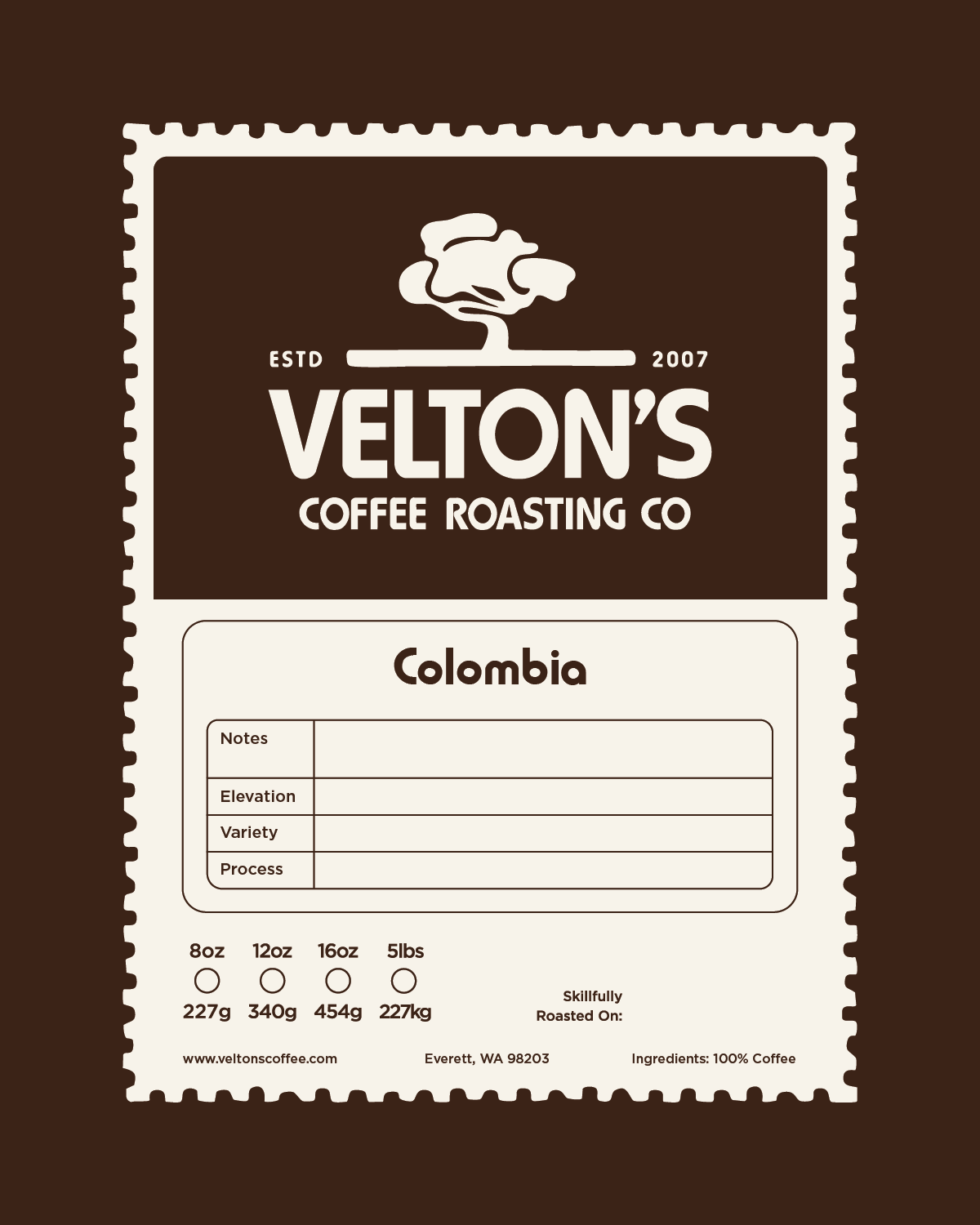
Tasting notes: Vibrant and nuanced with lemonade, green apple, pomelo, and wild blueberries.
Country: Colombia
Region: El Tablón de Gómez, Nariño
Producer: Smallholder farmers
Elevation: 2000 - 2150 MASL
Variety: Castillo, Caturra, Tabi
Processing: Honey Process
Couldn't load pickup availability
We roast to order & ship on Tuesdays.
We roast to order & ship on Tuesdays.
Website orders are roasted and packed every Monday and picked up Tuesday by USPS for delivery. As we only roast exactly as much of each coffee as we have known orders for, please be sure and place your order no later than 10 AM (PST) on Monday for fulfillment that week. Orders that come in later than that may not be fulfilled until the following week.
$8 flat rate shipping, free over 8 lbs
$8 flat rate shipping, free over 8 lbs
Orders weighing 0 - 7.99 pounds ship for $8.00.
Orders weighing 8 pounds or more ship for free!
About this coffee
Aponte is a reknowned coffee growing community in Nariño, Colombia, where indigenous Inga producers cultivate coffee on communal lands. Specialty coffee is key to the community's identity, representing an economic avenue by which the Inga regained control after the armed conflict of the 80s and 90s. The area is a self-governing Indigenous territory — an autonomy Colombia's constitution recognizes — with working institutions: a Cabildo Mayor drawn from all nine communities, and nine Cabildos Menores, ministries in effect, for justice, education, health, women and gender, public services, sport and the economy. The coffee program answers to the Cabildo Menor de Economía, coordinated today by a twenty-two-year-old studying international business in Pasto: the generation the peace was planted for. More than seven hundred producers now grow coffee inside the territory; walk its nine communities and the roofs and patios are covered with drying parchment, in a territory poppy once ruled.
Although they grow typical varieties such as Castillo and Colombia, Aponte producers deviate from the standard washed process in favor of honey processing as their preferred method, in part because of the water it saves. Done carelessly, the honey method fails. Done with the patience this community holds in surplus, the seed dries in contact with its own sugars and the resulting cup is layered and extremely sweet. The region’s volcanic soils, cool mountain climate, and elevations reaching over 2,000 meters means trees grow slowly and cherries stay small and dense, which contributes to the exceptional quality and complexity of Aponte's coffees.
History of Colombian Coffee
As with many coffee origins, it is believed that coffee was first brought to Colombia by priests, arriving, perhaps, within a decade or two after coffee first came to the Americas via the Caribbean in the first half of the 17th century. It was likely a garden crop grown for local consumption and barter for decades. Unlike other coffee regions, we have the story of a priest named Francisco Romero, who could be called the father of commercial coffee cultivation in Colombia. The folkloric tale goes that in the early 1800s, Father Francisco, hearing confessions in the northeastern town of Salazar de la Palmas, assigned planting coffee to his parishioners as penance for their sins. The Archbishop of Colombia heard about this and ordered all priests to adopt the practice. Commercial production of coffee expanded quickly, moving into regions where the growing conditions were ideal.
Growing Coffee in Colombia
Even though it’s been 4,000 years, the soil resulting from the last major eruption of Tolima is still considered “young soil,” filled with nutrients that are no longer found at the same levels in old soil. There is a long list of elements on offer in volcanic soil that are fading or absent in other soils, such as high levels of potassium and nitrogen. Also present is something called “Boron,” which arrived from outer space a long time ago, and is important to cell walls, the creation of enzymes, and the production of flowers and fruit, meaning Boron contributes to yield. Beyond the nutrients, the structure of volcanic soil is also beneficial to coffee growing. It can soak up and hold moisture while, at the same time, facilitating good drainage so water doesn’t pool, which is not good for coffee plant roots. Coffee plants like to take a drink, then take a break. Also, volcanic soils are usually found on an incline, which also helps with drainage.